

Quick answer: Under $2,000 in 2026, the strongest buy is a real Gen 2+ autogated white-phosphor PVS-14 at $1,749.95 — the only thing in the bracket that runs on starlight alone. Under $1,000, the HEAT + VIPER dual-spectrum kit at $749 complete covers finding and seeing. Under $300, the VIPER at $249.95 is the honest entry. The hero image is all of it tested on one scene, 13 percent moon, no IR — the field sorts itself.
What does the moonlight shootout actually show?
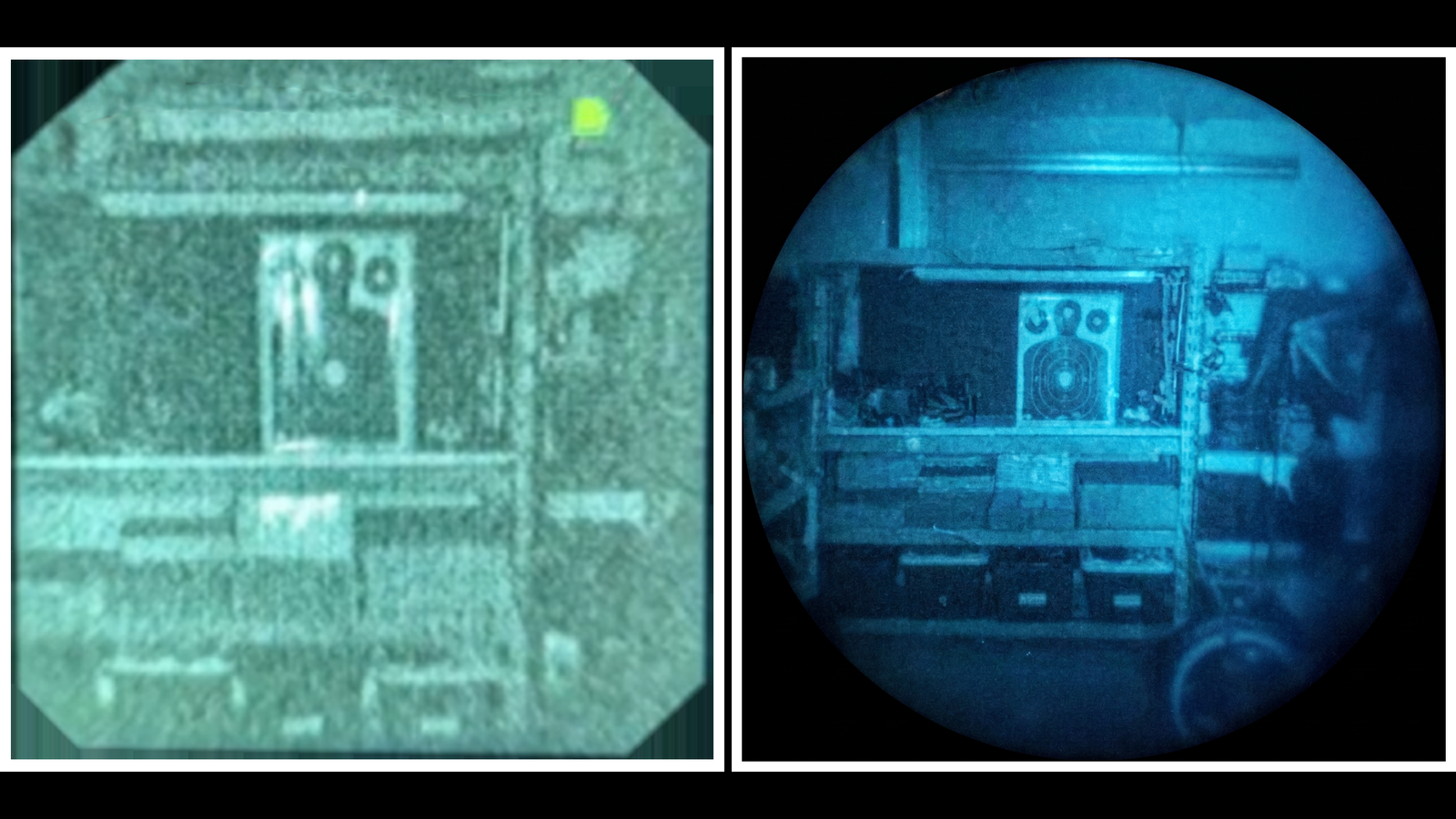
The hero image is a real test an independent reviewer shot for us: the same fallen tree, 13 percent waxing crescent, no IR lighting, photographed through seven devices. The two analog PVS-14 tubes (Gen 2+ and Gen 3) render the scene; the digital units in the $200-700 class render noise with a scene hiding in it. That is not brand rhetoric — it is what a photon supply looks like when a tube multiplies it and a sensor merely samples it.
Two honest observations from the same frame: the Gen 2+ and Gen 3 tubes are nearly indistinguishable (the price gap between them is interrogated in Gen 2+ vs Gen 3), and the digital units are not useless — they are simply a different, IR-dependent tier that costs a tenth as much.
What are the real picks at each price bracket?
| Price bracket | Pick (July 2026) | What you get | What you give up |
|---|---|---|---|
| Under $300 | VIPER - $249.95 | Digital NV, built-in 850nm IR, records video | IR-dependent past twilight; screen image |
| Under $700 | HEAT - $649 | 12µm 25mK thermal; finds anything warm | No terrain detail; not night vision |
| Under $1,000 | HEAT + VIPER kit - $749 complete | Both spectrums bridged on one helmet | Neither eye is an analog tube |
| Under $2,000 | PVS-14 - $1,749.95 | Real Gen 2+ tube, starlight-capable, QC sheet | Single eye; thermal sold separately |

Why is the PVS-14 the bracket winner?
Because $1,749.95 is the crossover point where you stop buying sensors and start buying a tube. Everything below this line needs help — an IR torch, a heat signature, a bright moon. A Gen 2+ autogated tube needs a clear night sky, full stop. It is also the only pick in the bracket with a documented resale story: the per-tube QC sheet that proves what you bought keeps proving it when you upgrade and pass it on.
The trap to avoid at this price is the undocumented "Gen 2" import at $1,200-1,500 through marketplaces: no measured sheet, no FOM, no way to know whether you bought a crisp tube or a factory second. If the seller cannot show the measurement, the discount is the warning. Our spec-sheet teardown of that corner of the market is in PVS-14 spec sheets compared.
When is the $749 kit the smarter buy than the $1,749.95 tube?
When your nights are about detection first. A property owner whose real question is "what is setting off the dogs" gets more from thermal-plus-digital at $749 than from a single beautiful tube — heat finds the answer in seconds, and the VIPER eye walks you to it. The full decision tree is in night vision or thermal. The honest hierarchy: detection problems want the kit; movement and identification problems want the tube; serious users eventually own both, which is why the PVS-14 bridges with the HEAT later (combos from $2,249.95).

What should you skip entirely?
Three things. Undocumented analog imports, as above. "Gen 1" units at $300-500 — the shootout's noisiest frames are what that money buys, and the VIPER beats them at half the price with a warranty. And any device whose listing leads with magnification instead of sensor or tube specs; night optics live and die on light handling, and 8x zoom on a starved sensor is 8x noise. The same dark-room evidence, indoors this time, is in digital vs analog:
Our pick under $2,000: put the whole bracket on the tube. PVS-14 — $1,749.95, Gen 2+ autogated white phosphor, per-tube QC sheet, free G24 helmet mount, 1-year warranty.
Frequently asked questions
What is the best night vision under $2,000 in 2026?
A real Gen 2+ autogated white-phosphor PVS-14 at $1,749.95 sold direct — the only starlight-capable option in the bracket, shipped with its tube's measured QC sheet and a free G24 helmet mount.
Is anything under $500 worth buying?
The VIPER at $249.95, for close-range use with its built-in IR torch — and it records video. Skip Gen 1 analog units in that range; the digital sensor beats them on every axis that matters.
Should I buy thermal or night vision under $1,000?
If the job is finding warm animals, thermal (HEAT, $649). If it is both finding and moving, the HEAT + VIPER kit at $749 complete puts both spectrums on one helmet for less than either job done twice.
Why do some Gen 2 units cost $1,200 and others $1,749.95?
Documentation and tube grade. An undocumented import may carry any tube the factory had that week; a measured unit ships with resolution, SNR, and FOM on paper for its serial number. The $500 difference is knowing what you own.
One scene, seven devices, no IR - the hero image already made the recommendation. Every Night Operators order includes the per-tube QC sheet, a free G24 helmet mount, and a 1-year manufacturer warranty, with 17,000+ orders shipped since 2023. The PVS-14 costs $1,749.95.